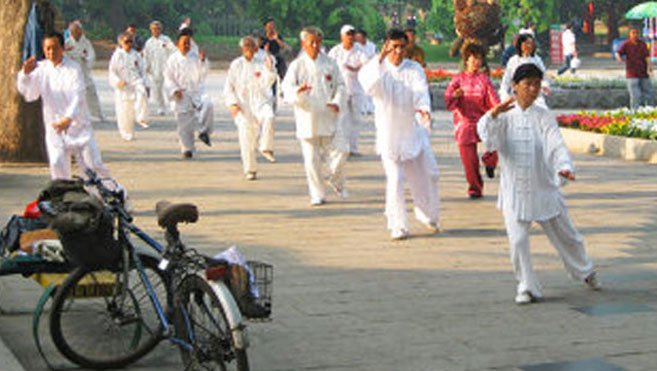
Qigong
氣功
“Life Energy Cultivation”
Traditional view
Traditionally, the central focus of qigong practice is to cultivate and balance qi as it affects mind (心), body (身), and spirit (靈). In Chinese philosophy, the concept of qi as a form of pervasive life energy includes original qi that a person has at birth, and qi a person acquires from air, water, food, sunlight, and interaction with the environment. A person is believed to become ill or die when qi becomes diminished or unbalanced. Health is believed to be returned by rebuilding qi, eliminating qi blockages, and correcting qi imbalances.
Main article: Traditional Chinese medicine
Traditional Chinese medicine focuses on tracing and correcting underlying disharmony, in terms of deficiency and excess, using the complementary and opposing forces of yin and yang, to create a balanced flow of qi. Qi is believed to be cultivated and stored in three main dantian energy centers and to travel through the body along twelve main meridians, with numerous smaller branches and tributaries. The main meridians correspond to twelve main organs (Zàng fǔ). Qi is balanced in terms of yin and yang in the context of the traditional system of Five Phases (Wu xing 五行). These traditional concepts do not translate readily to modern science and medicine.
Principles
Whether viewed from the perspective of exercise, health, philosophy, or martial arts training, several main principles emerge concerning the practice of qigong:
Intentional movement: careful, flowing balanced style
Rhythmic breathing: slow, deep, coordinated with fluid movement
Awareness: calm, focused medititative state
Visualization: of qi flow, philosophical tenets, aesthetics
Additional principles:
Softness: soft gaze, expressionless face
Solid Stance: firm footing, erect spine
Relaxation: relaxed muscles, slightly bent joints
Balance and Counterbalance: motion over the center of gravity
Advanced goals:
Equanimity: more fluid, more relaxed
Tranquility: empty mind, high awareness
Stillness: smaller and smaller movements, eventually to complete stillness
The most advanced practice is generally considered to be with little or no motion.
Contemporary view
Similar to the subject of efficacy of Traditional Chinese medicine, the chasm between the Eastern tradition of qi and the Western scientific viewpoints is not insurmountable if the analysis is limited to the effect of qigong practice on biological processes without demanding a material interpretation of qi. There is convincing argument to view the concept of qi as a metaphor for biological processes and in the emerging field of energy medicine.
The basis of qigong can also be explained in terms of contemporary views of health, science, meditation, and exercise, and using medical concepts such as stress management, biofeedback, and neurology.
|